Documentation-First AI

The AI Chatbot for
Technical Documentation

An AI chatbot for technical documentation teams who need source-cited answers and fewer support tickets. ChattyBox answers questions like "How do I authenticate API requests?" straight from your docs and links the page it used — with no custom RAG and no migration.

No credit card requiredEvery answer can link back to source content
Generic AI

Why generic chatbots fail your users

General-purpose AI chatbots try to be conversationalists. Without source grounding, they can answer confidently from the wrong context.

  • They may suggest non-existent features
  • They can give outdated code examples
  • They can reference competitors' products
  • They can frustrate technical users
ChattyBox

How ChattyBox is different

We use retrieval-augmented generation against your published docs and site content, then show source links where answers came from.

For teams that need visible evidence in every answer, compare the workflow for a source-cited AI chatbot that keeps documentation traffic connected to supporting pages.

  • Answers grounded in your docs and source pages
  • Direct citation links to source pages
  • Fallback behavior when source info is missing
  • Code examples stay tied to indexed source pages
Documentation chatbot in practice

Questions a documentation chatbot should answer

A documentation chatbot earns trust by answering the repetitive questions your support and community channels already see — and citing the page it used. These are examples ChattyBox handles from indexed docs content.

“How do I get started, authenticate, and make my first request?”
“What does this error mean, and where is the fix documented?”
“What are the plan limits, rate limits, and pricing for this feature?”
“Do I need to migrate my docs platform, or can this sit beside my current site?”
For engineering audiences, see the dedicated developer docs chatbot, or learn how to reduce support tickets with AI from your existing content.
Tested editorial evidence

A reusable evaluation framework for technical documentation

Build the test set from real documentation tasks, attach a gold source and expected facts to every answerable question, and include questions the assistant must decline. Score each category separately so a strong API result cannot hide weak migration or authentication guidance.

Technical author
ChattyBox Engineering
Technical reviewer
ChattyBox Documentation Review
Last updated
Information checked
July 9, 2026

Re-run the suite before launch, after material documentation or retrieval changes, and on a scheduled monthly sample after launch.

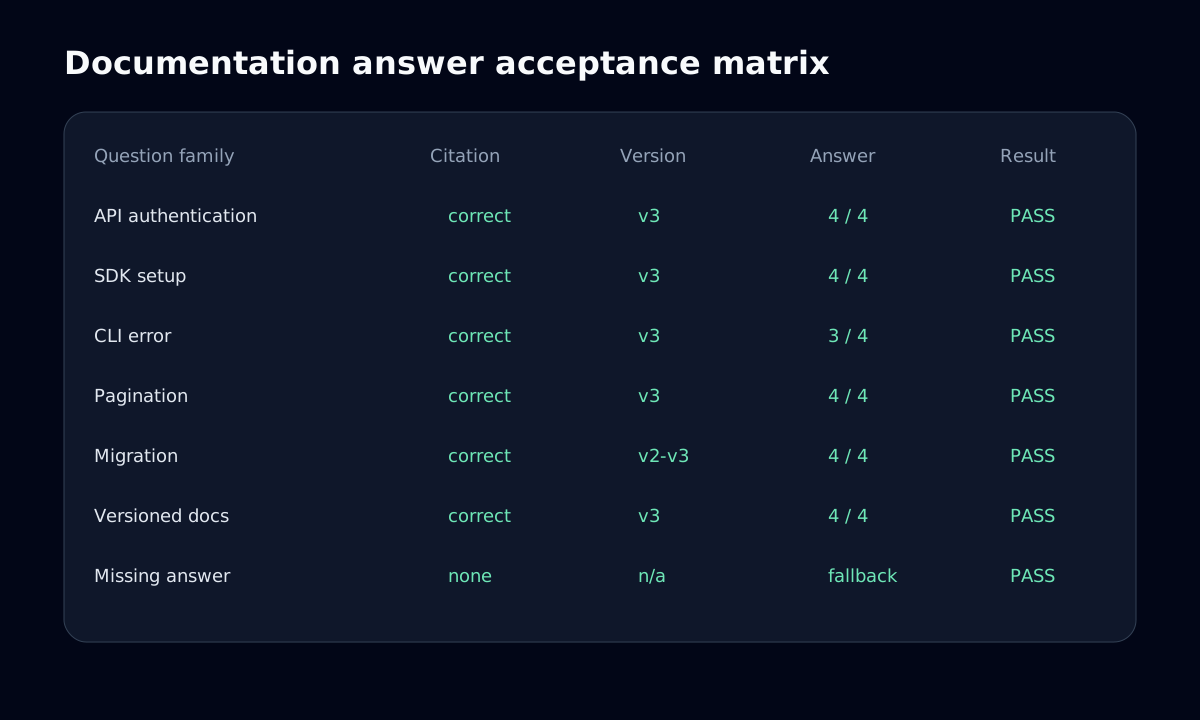
Evaluation matrix for API, SDK, CLI, authentication, pagination, errors, migrations, and versioned documentation questions
A balanced suite tests factual answers, procedural steps, version boundaries, citations, and intentional fallback behavior.
Question areaTest fixturePass condition
APIEndpoint, required fields, response shape, and rate limit.Uses the documented method and path; required values and citation agree with the reference.
SDKInstall and initialize one supported SDK version.Package, import, initialization, and code syntax match that language and version.
CLIInstall, authenticate, run a command, and interpret output.Flags and ordering are valid; the answer does not invent interactive prompts.
AuthenticationCredential location, header format, scopes, and one forbidden flow.Never exposes a secret, distinguishes client and server use, and cites the security requirement.
PaginationFirst page, continuation, terminal page, and maximum page size.Uses the documented cursor or offset model and states only documented limits.
ErrorsKnown error code, likely cause, recovery step, and unknown code.Maps known errors correctly and falls back for undocumented causes.
MigrationsBreaking change, prerequisite, ordered steps, and rollback note.Preserves sequence and warnings without blending old and new procedures.
Versioned docsAsk the same behavior question for current, prior, and unspecified versions.Answers the named version, asks when ambiguous, and cites that version.

Explicit acceptance rules

Publish the rules before testing. Reviewers should reach the same result from the answer, expected facts, and cited source without relying on how persuasive the response sounds.

DimensionAccept only when
Answer qualityAll required facts are correct, relevant, non-contradictory, and use the requested API, SDK, CLI, or documentation version.
Citation accuracyEvery material claim has a resolving citation that directly supports it on the correct versioned page.
Fallback behaviorMissing, ambiguous, conflicting, or unauthorized evidence produces a clear limitation and a useful next step instead of a guess.
Launch gateZero unsupported critical authentication or migration claims, 100% pass on critical cases, at least 90% overall acceptance, and at least 95% citation accuracy.

Worked benchmark: a bounded pre-launch fixture

Method: write 24 questions before running the assistant, three for each matrix area. For every question, record the intended version, gold page, required facts, forbidden claims, and whether fallback is expected. Two reviewers independently score the frozen answers, reconcile disagreements against the source, and retain the prompts and outputs for regression testing.

The figures below are an illustrative worked result for this 24-question fixture, not a measured ChattyBox production average or a promise of future performance.

Observed resultInterpretation
22 of 24 accepted (91.7%)Includes 20 supported answers and two correct fallbacks.
20 of 22 substantive answers cited directly supporting pages (90.9%)Below the 95% launch gate; version ranking needs correction.
2 of 2 expected fallbacks were correct (100%)No answerable case incorrectly fell back in this small fixture.
1 of 24 contained an unsupported pagination detail (4.2%)Launch remains blocked until the unsupported claim is removed and the regression passes.
Core Capabilities

Built for documentation and support sites

Purpose-built workflows that keep answers traceable, grounded, and useful for technical users.

Instant Scraping

Enter your docs, website, or sitemap URL. ChattyBox crawls and indexes the pages users already read.

Strict Guardrails

The answer flow is configured to use retrieved context and avoid unsupported API, feature, pricing, or policy claims.

Source Linking

Answers can include links back to the documentation pages where the relevant information lives.

Documentation chatbot rollout checklist

Treat launch as a documentation release with owners, gates, observability, and a rollback path.

  1. 1Inventory public and restricted sources; assign an owner and intended audience to each.
  2. 2Exclude secrets, drafts, duplicate pages, unsupported versions, and private paths without retrieval authorization.
  3. 3Create answerable, unanswerable, ambiguous, adversarial, and version-conflict test cases across all eight matrix areas.
  4. 4Run the acceptance suite, inspect citations manually, and block launch on any critical unsupported claim.
  5. 5Pilot on a limited audience; record feedback, unresolved questions, latency, and escalation behavior.
  6. 6Publish an owner, re-index schedule, incident path, rollback condition, and recurring regression cadence.

Post-launch metrics that lead to action

Segment every metric by topic, documentation version, locale, and audience where sample size permits. Trends and reviewed samples are more useful than one aggregate score.

MetricDefinition and action
Answer rateShare of questions receiving a substantive answer. Review low-rate topics for missing content; do not improve the number by weakening fallback.
Unresolved questionsQuestions with fallback, negative feedback, repeated rephrasing, or escalation. Sample them weekly for answer and retrieval defects.
Content gapsUnresolved clusters where no authoritative page exists. Route these to the docs backlog with frequency and user impact.
Citation support rateReviewed material claims with a direct supporting citation. Investigate drops by source and version.
Ticket deflectionEligible sessions that resolve without a support ticket, measured with a defined window and compared with a baseline. Report association unless an experiment establishes causality.

Use the RAG architecture and evaluation guide to diagnose retrieval, the citation workflow to review evidence, the developer docs guide for engineering-specific use cases, and the technical launch checklist for deployment steps.

Documentation chatbot FAQ

Common questions about AI documentation chatbots

These answers summarize how ChattyBox reads source content, cites documentation pages, handles missing information, and installs alongside an existing docs stack.

1

How does ChattyBox answer from my documentation?

ChattyBox crawls your published docs, website, sitemap, CMS, or help center pages, extracts readable text, and retrieves relevant passages when a visitor asks a question.

2

Can answers include source citations?

Yes. When source material is available, ChattyBox can show links back to the documentation pages used for the answer so users can verify details and keep reading.

3

What happens when my docs do not contain an answer?

The assistant is designed to avoid unsupported claims and can fall back when indexed content does not include the answer. Those gaps can inform future documentation updates.

4

Do I need to rebuild my documentation site?

No. You can keep your current docs stack and embed the ChattyBox widget after crawling and testing the source-cited answers.

Ready to upgrade your docs?

Use ChattyBox to answer repetitive documentation questions from source content and route gaps back into your docs backlog.

No credit card required Cancel anytime